Sunday, August 21, 2011

Monday, June 13, 2011
Friday, June 10, 2011
Thursday, June 9, 2011
Friday, May 27, 2011
Solar Max
The coming year will be an important one for space weather as the sun pulls out of a trough of low activity and heads into a long-awaited and possibly destructive period of turbulence.
Many people may be surprised to learn that the sun, rather than burn with faultless consistency, goes through moments of calm and tempest.
But two centuries of observing sunspots -- dark, relatively cool marks on the solar face linked to mighty magnetic forces -- have revealed that our star follows a roughly 11-year cycle of behavior.
The latest cycle began in 1996 and for reasons which are unclear has taken longer than expected to end.
Now, though, there are more and more signs that the sun is shaking off its torpor and building towards "Solar Max," or the cycle's climax, say experts.
"The latest prediction looks at around midway 2013 as being the maximum phase of the solar cycle," said Joe Kunches of NASA's Space Weather Prediction Center.
But there is a prolonged period of high activity, "more like a season, lasting about two and a half years," either side of the peak, he cautioned.
At its angriest, the sun can vomit forth tides of electromagnetic radiation and charged matter known as coronal mass ejections, or CMEs.
This shock wave may take several days to reach Earth. When it arrives, it compresses the planet's protective magnetic field, releasing energy visible in high latitudes as shimmering auroras -- the famous Northern Lights and Southern Lights.
But CMEs are not just pretty events.
They can unleash static discharges and geomagnetic storms that can disrupt or even knock out the electronics on which our urbanized, internet-obsessed, data-saturated society depends.
Less feared, but also a problem, are solar flares, or eruptions of super-charged protons that can reach Earth in just minutes.
In the front line are telecommunications satellites in geostationary orbit, at an altitude of 36,000 kilometers (22,500 miles) and Global Positioning System (GPS) satellites, on which modern airliners and ships depend for navigation, which orbit at 20,000 kilometers (12,000 miles).
In January 1994, discharges of static electricity inflicted a five-month, 50-million-dollar outage of a Canadian telecoms satellite, Anik-E2.
In April 2010, Intelsat lost Galaxy 15, providing communications over North America, after the link to ground control was knocked out apparently by solar activity. Intelsat appears to have regained some control of the satellite, but it's too early to tell if it will be fully operational again.
"These are the two outright breakdowns that we all think about," said Philippe Calvel, an engineer with the French firm Thales. "Both were caused by CMEs."
In 2005, x-rays from a solar storm disrupted satellite-to-ground communications and GPS signals for about 10 minutes.
To cope with solar fury, satellite designers opt for robust, tried-and-tested components and shielding, even if this makes the equipment heavier and bulkier and thus costlier to launch, said Thierry Duhamel of satellite maker Astrium.
Another precaution is redundancy -- to have backup systems in case one malfunctions.
On Earth, power lines, data connections and even oil and gas pipelines are potentially vulnerable.
An early warning of the risk came in 1859, when the biggest CME ever observed unleashed red, purple and green auroras even in tropical latitudes.
The new-fangled technology of the telegraph went crazy. Geomagnetically-induced currents in the wires shocked telegraph operators and even set the telegraph paper on fire.
In 1989, a far smaller flare knocked out power from Canada's Hydro Quebec generator, inflicting a nine-hour blackout for six million people.
A workshop in 2008 by US space weather experts, hosted by the National Academy of Sciences, heard that a major geomagnetic storm would dwarf the 2005 Hurricane Katrina for costs.
Recurrence of a 1921 event today would fry 350 major transformers, leaving more than 130 million people without power, it heard. A bigger storm could cost between a trillion and two trillion dollars in the first year, and full recovery could take between four and 10 years.
Saturday, March 19, 2011
Tuesday, February 22, 2011
Panic stations! New theory behind climate change
The Earth's magnetic pole is inexplicably shifting, creating unstoppable forces generating monster storms which we have seen at the beginning of 2011. There is evidence that a cycle of super-storms has started, the latest being the gigantic ice storm across North America. Is this the beginning of a new Ice Age?
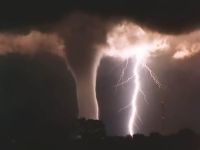 Frightening new evidence begins to surface about the Earth's wobble, its effect on the climate and the beginning of a new Ice Age, heralded by a series of monster storms such as those unleashed on the UK in late 2010, the USA before Christmas and now again at the beginning of February and Eastern Australia, first with its worst flooding ever and then with a Category 5 hurricane.
The latest storm to hit the USA has affected 150 million people and stretches across 2,000 miles of territory, according to the research presented in the article "Magnetic polar shifts causing massive global superstorms"*. In Australia, unprecedented rains saw sharks swimming along the streets of towns and so much water fell, that "Shocked authorities now numbly concede that some of the water may never dissipate and have wearily resigned themselves to the possibility that region will now contain a small inland sea".
Then struck Yasi with its winds of almost 200 mph - 22 per cent faster that a Category 5 hurricane. "Yet Yasi may only be a foretaste of future super-storms. Some climate researchers, monitoring the rapidly shifting magnetic field, are predicting super-storms in the future with winds as high as 300 to 400mph," states researcher Terrence Aym.
What is happening?
According to the research, a change in the Sun's electromagnetic field is reacting with the Earth's, having an effect not only on the Earth's magnetosphere, but also its wobble, the dynamics of its core, the Ocean currents and the weather. The result is that the Earth's magnetic core has been shifting 40 miles to the East annually over the last decade, as opposed to the 5-mile average. Worse, it is accelerating.
Terrence Aym reveals NASA reports which indicate the Earth's magnetic field now shows cracks, affecting the ionosphere and troposphere wind patterns; the work also quotes the Federal Agency NOAA, which "issued a report caused a flurry of panic when they predicted that mammoth superstorms in the future could wipe out most of California."
Even more worrying is the quote from The Economist in a detailed article about the magnetic field: "There is, however, a growing body of evidence that the Earth's magnetic
field is about to disappear, at least for a while. The geological record shows that it flips from time to time, with the south pole becoming the north, and vice versa. On average, such reversals take place every 500,000 years, but there is no discernible pattern. Flips have happened as close together as 50,000 years, though the last one was 780,000 years ago. But, as discussed at the Greenland Space Science Symposium, held in Kangerlussuaq this week, the signs are that another flip is coming soon."
Not only that...all the signs are there for the beginning of a new Ice Age.